When you click the link, it will take you to the corresponding page.
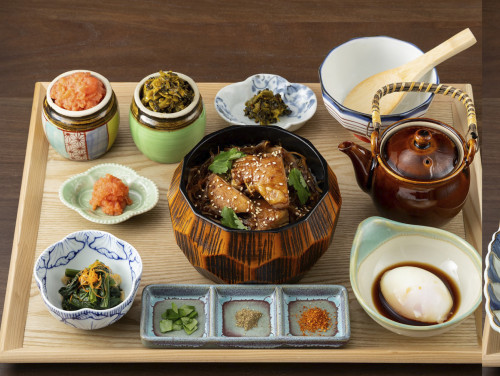
糸島どりの水炊き出汁茶漬け定食
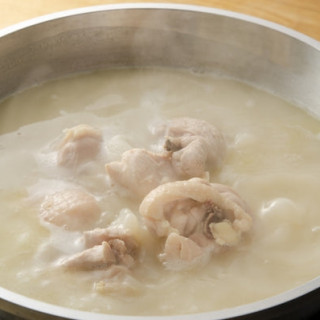
Mizutaki is a type of Japanese hot pot in which ingredients are simmered in water without any seasoning. The name comes from the words "mizu" (water) and "taki" (to cook or boil), meaning "a dish boiled in water." It is known as a local specialty of Hakata, along with motsunabe, but in fact, it has long been eaten in the Kansai region as well. In Kyushu, chicken is the main ingredient. Traditionally, chopped chicken was simmered in plain water, which gave rise to the name mizutaki. However, nowadays, it is common to simmer chicken in a prepared broth instead. The broth is typically made by slowly simmering chicken bones for a long time, resulting in a rich, cloudy soup. In the Kansai region, pork, beef, and even whale meat may also be used in addition to chicken. The ingredients are simmered in plain water with kombu (kelp) and eaten with ponzu sauce. In both Kyushu and Kansai, people enjoy finishing the meal by adding noodles or rice to the leftover broth. In Kyushu, noodles are typically added, while in Kansai, rice is added to make a porridge.
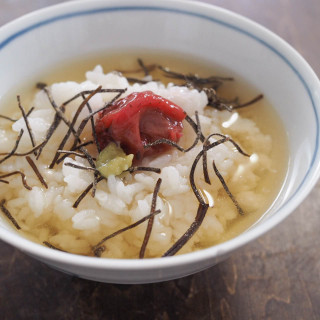
Ochazuke is a dish eaten by pouring tea over rice. It is common to see the culture of eating rice in broth or soup around the world, but eating tea is a unique food culture unique to Japan. In general, hot tea or broth is poured over it, but cold tea or broth is used to cool it down. In addition to rice and tea, it is eaten with various ingredients such as umeboshi and sashimi grilled salmon. Recently, instant ochazuke, which is made by simply pouring the powder over rice and adding hot water, is also popular. Ochazuke is usually eaten as a finishing meal after drinking alcohol. In Kyoto, there is a saying that when guests come home and want to go home quickly, they ask, "How about ochazuke?" This is a Kyoto-style twist, which means to go home quickly after eating ochazuke, the finishing meal. It is a characteristic of Kyoto people who speak around the world with a smile without revealing their intentions.